Black Friday week

Black Friday week

📄 Digital book in PDF · read it on your phone or print it

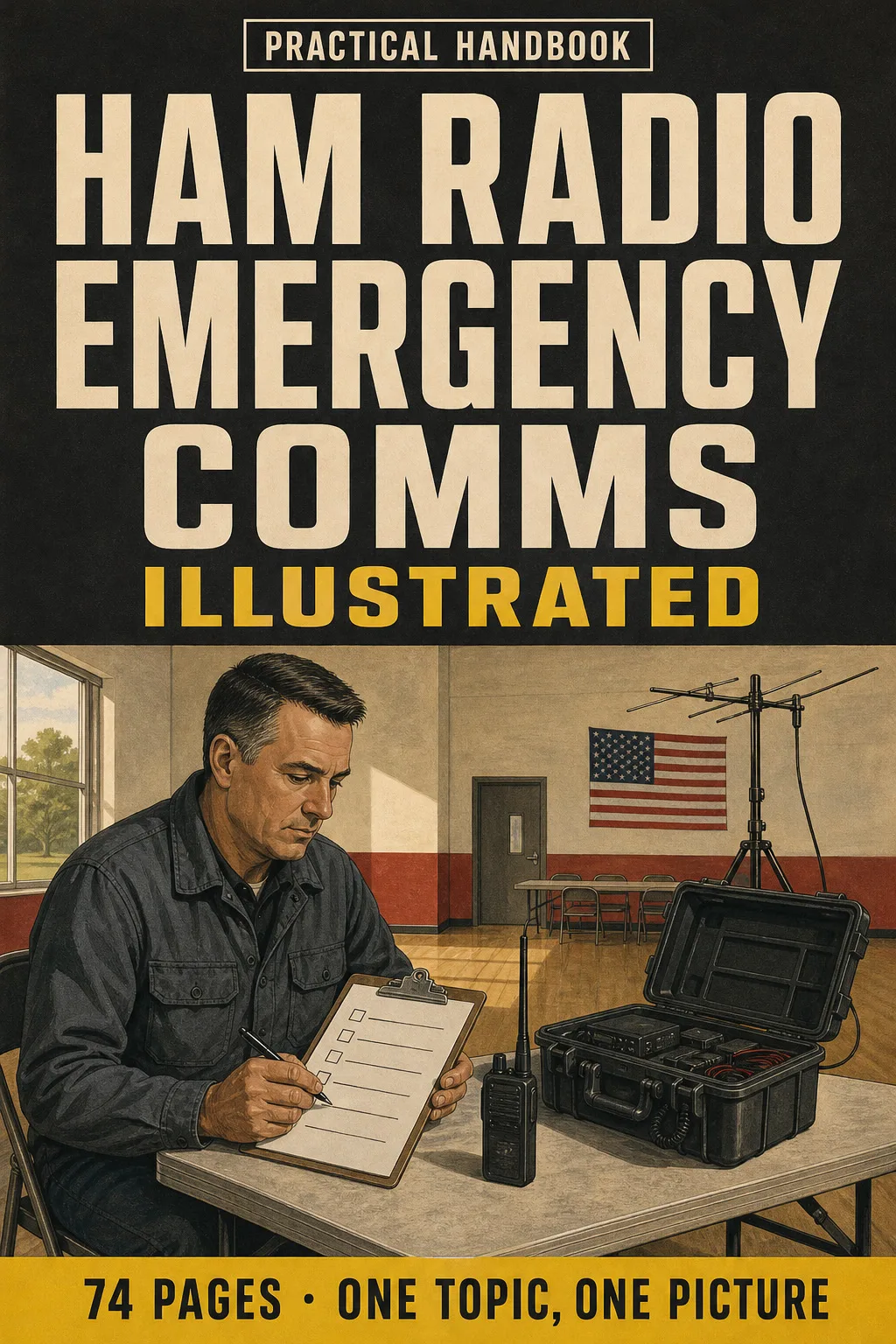
Ham Radio Emergency Comms, Illustrated: Know Your Next Step When the Repeater Goes Quiet One Field Task on Every Page

Go-kit, battery run-time, portable antennas, NVIS, repeaters, net check-ins, message forms and logging. Every topic has its own page: the drawing first, then what you need to remember. 74 illustrated pages.

LEARN IT ONE PAGE AT A TIME

🔒 Secure checkout · PDF by email · 30-day guarantee

Every topic, its own pageEach field procedure drawn, with the explanation right beside it
74 illustrated pages9 parts, from your role when the phones go down to the one-page summary
Up-to-date sourcesFCC amateur radio rules (47 CFR Part 97, eCFR) and FEMA NIMS/ICS guidance
PDF by emailFormat

Look Inside the Book

Every page has one big drawing and a box with the numbers, steps and rules you need to know:

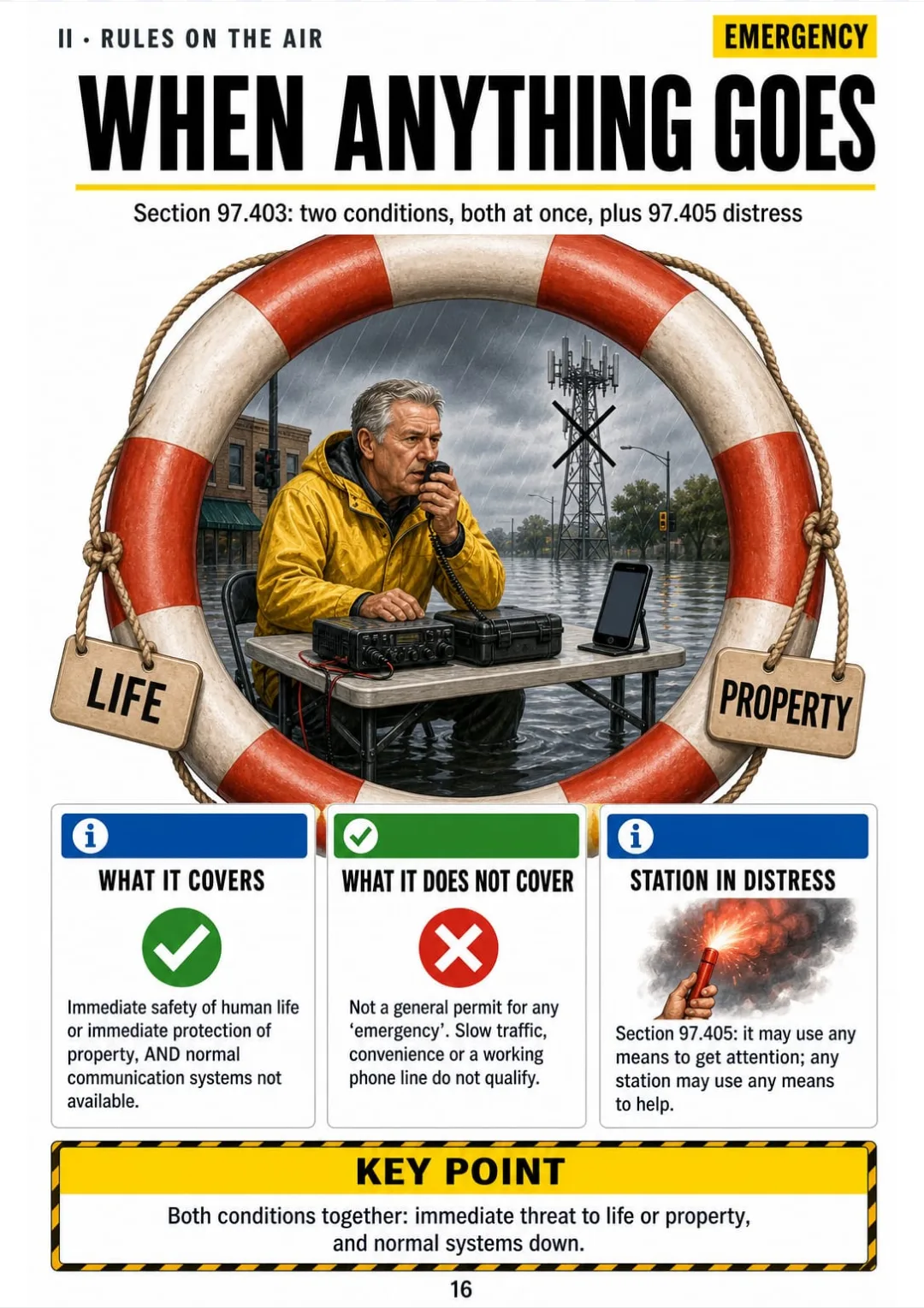
Section 97.403: immediate threat + normal systems down = any means at your disposal
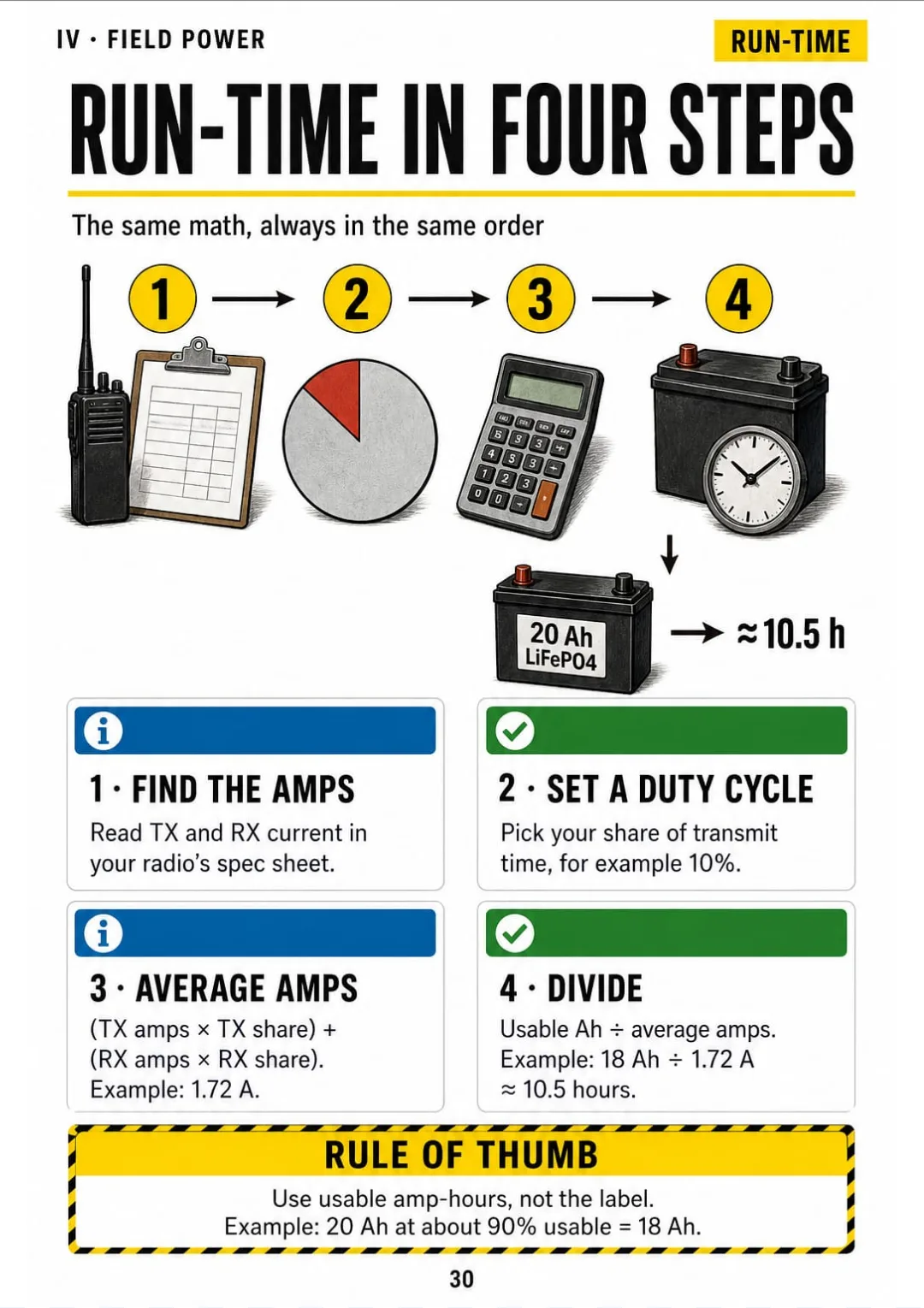
Usable Ah ÷ average amps = hours · 18 Ah ÷ 1.72 A ≈ 10.5 h
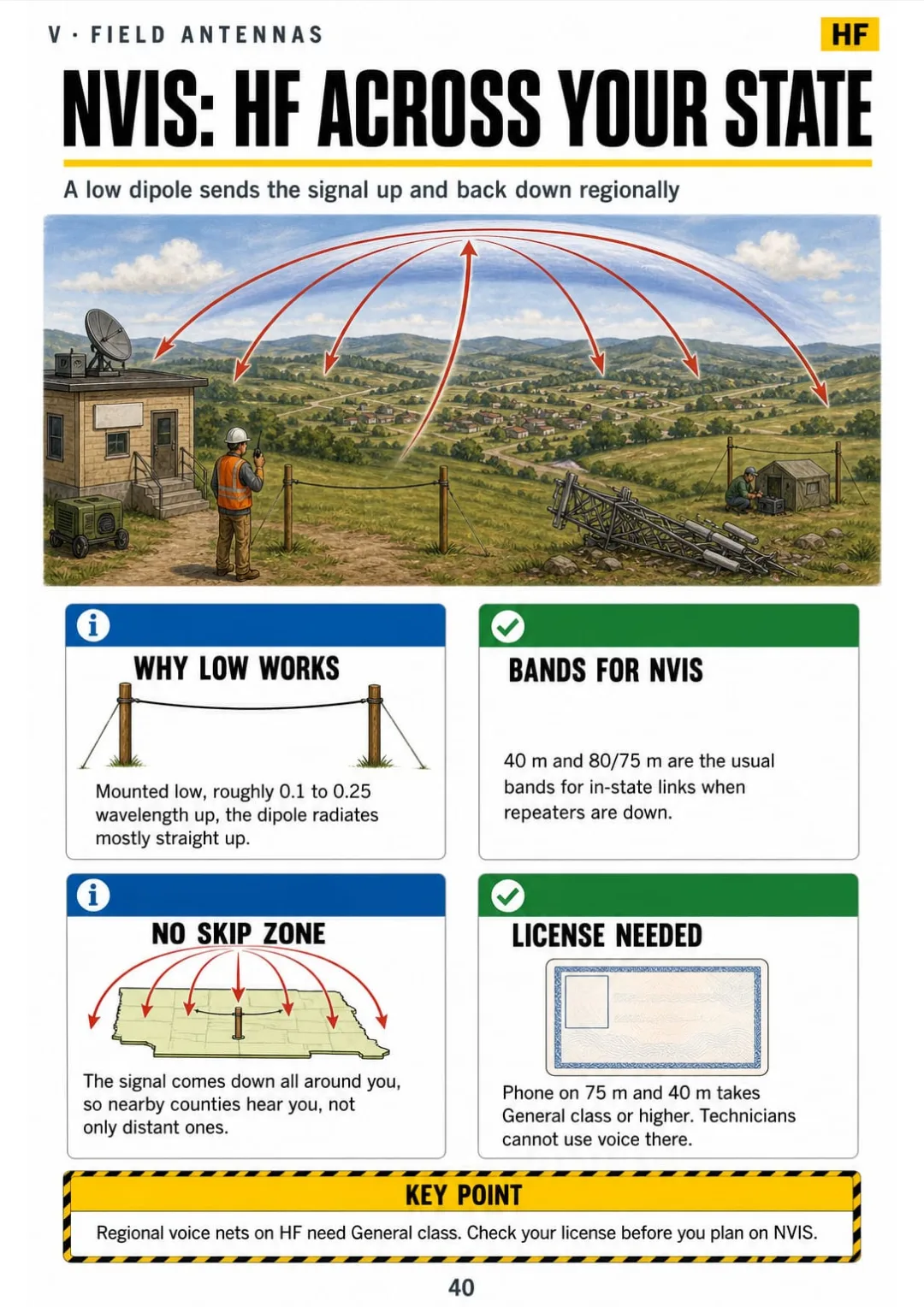
NVIS on 40 and 80/75 meters: a low dipole covers 0 to 300 miles when repeaters fail.
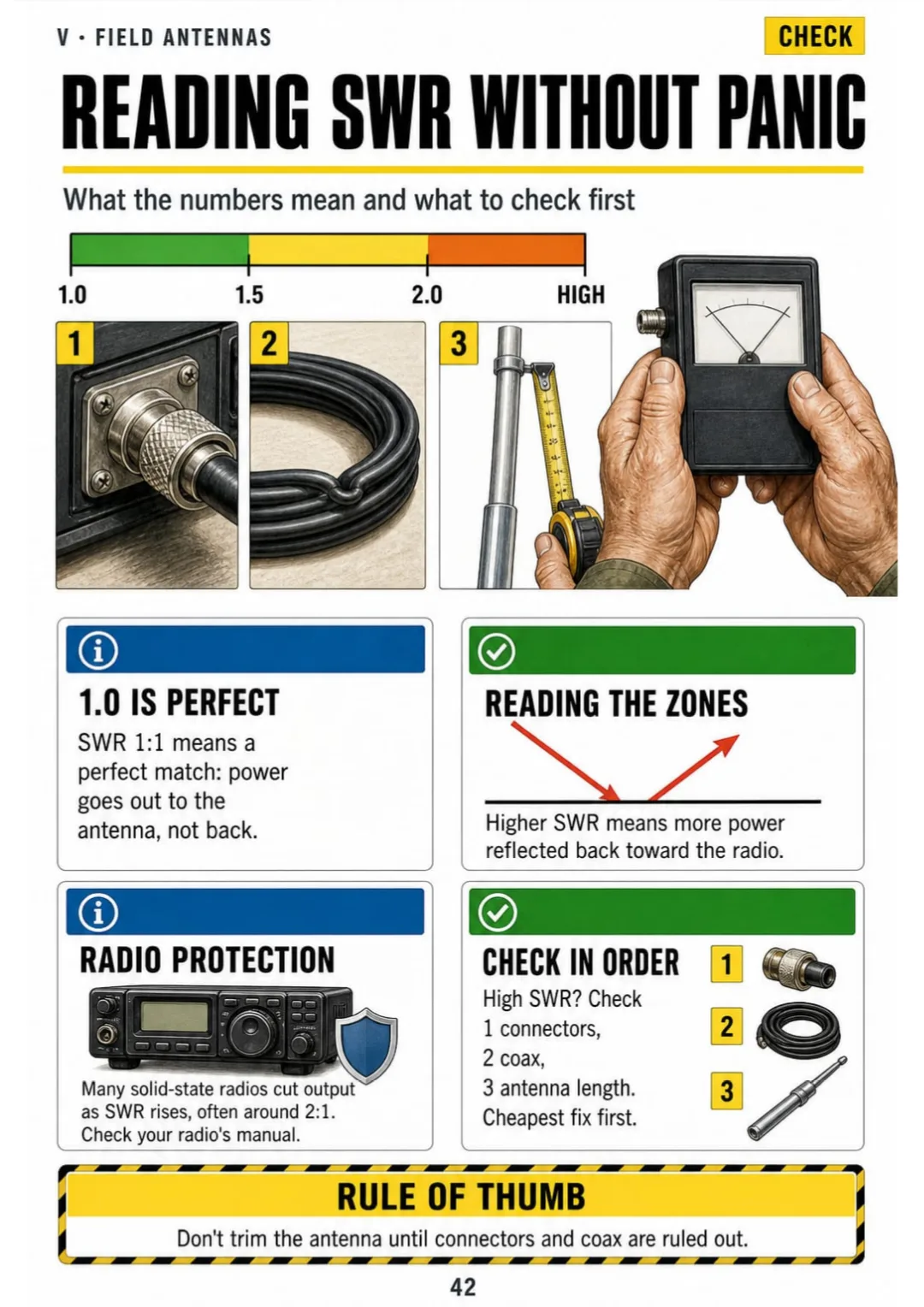
SWR 1:1 is perfect; check connectors, coax and antenna length, in that order.
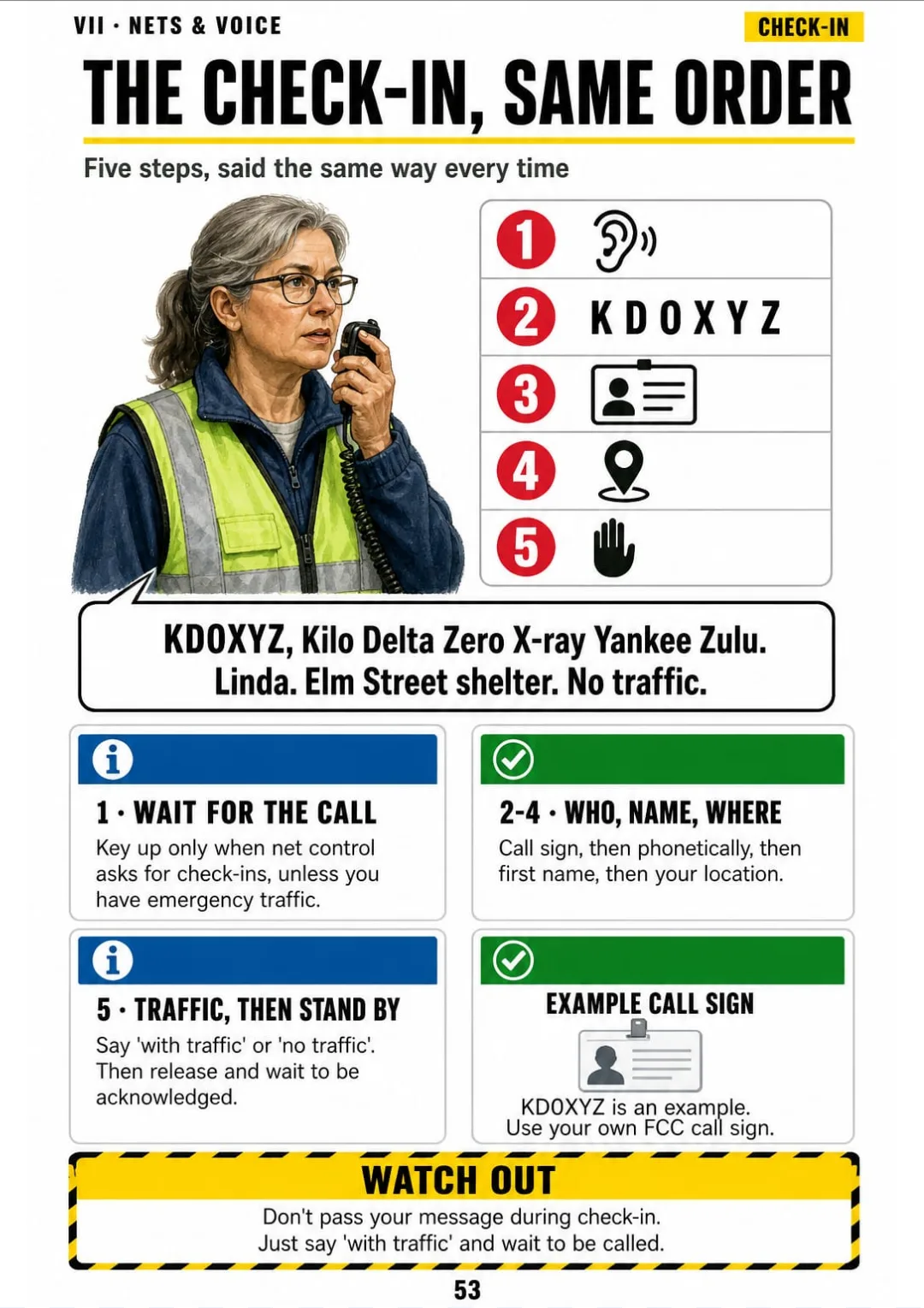
Check-in in 5 steps: wait, call sign phonetically, name, location, traffic
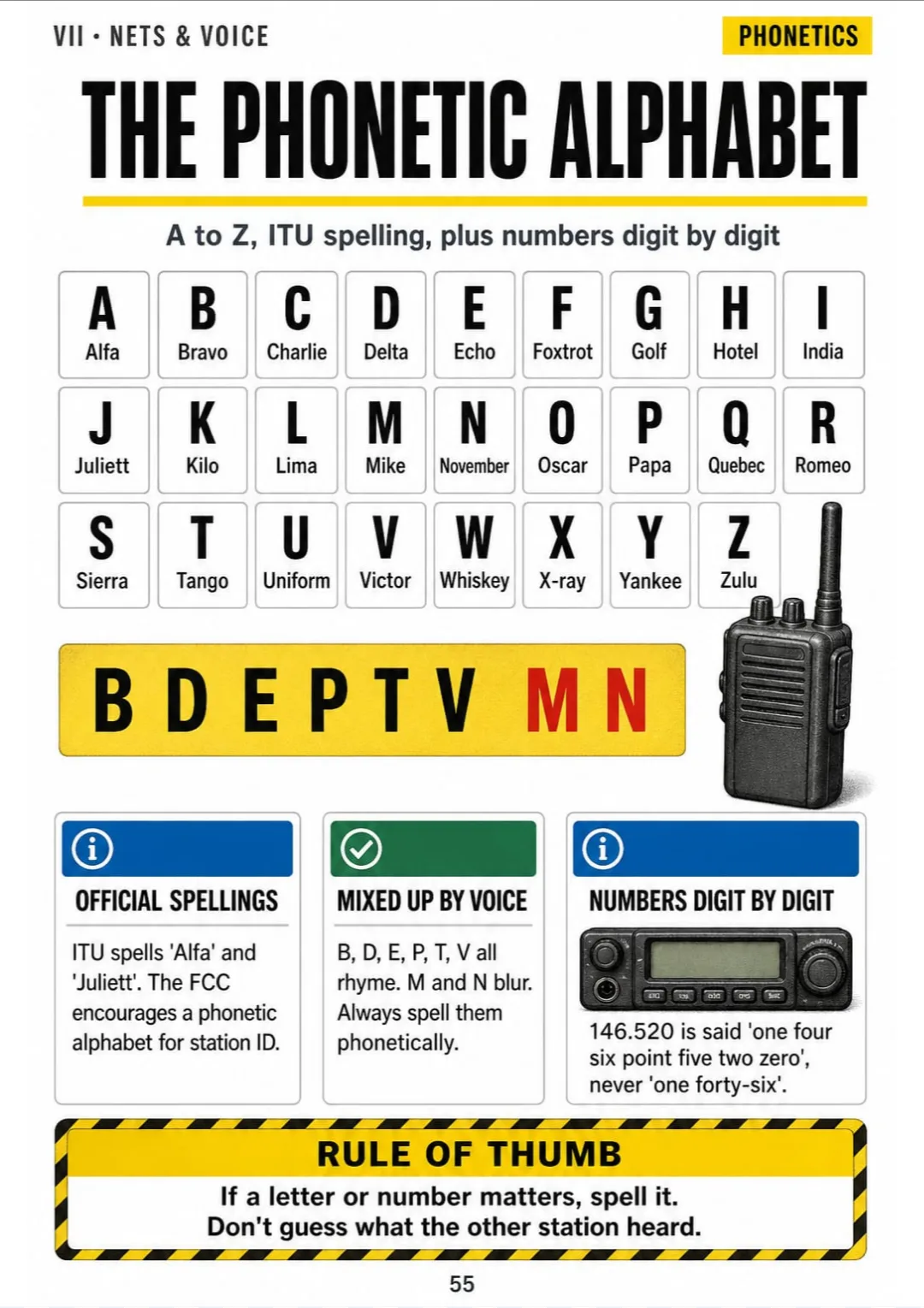
The full ITU phonetic alphabet, A to Z, plus the B/D/E/P/T/V trap
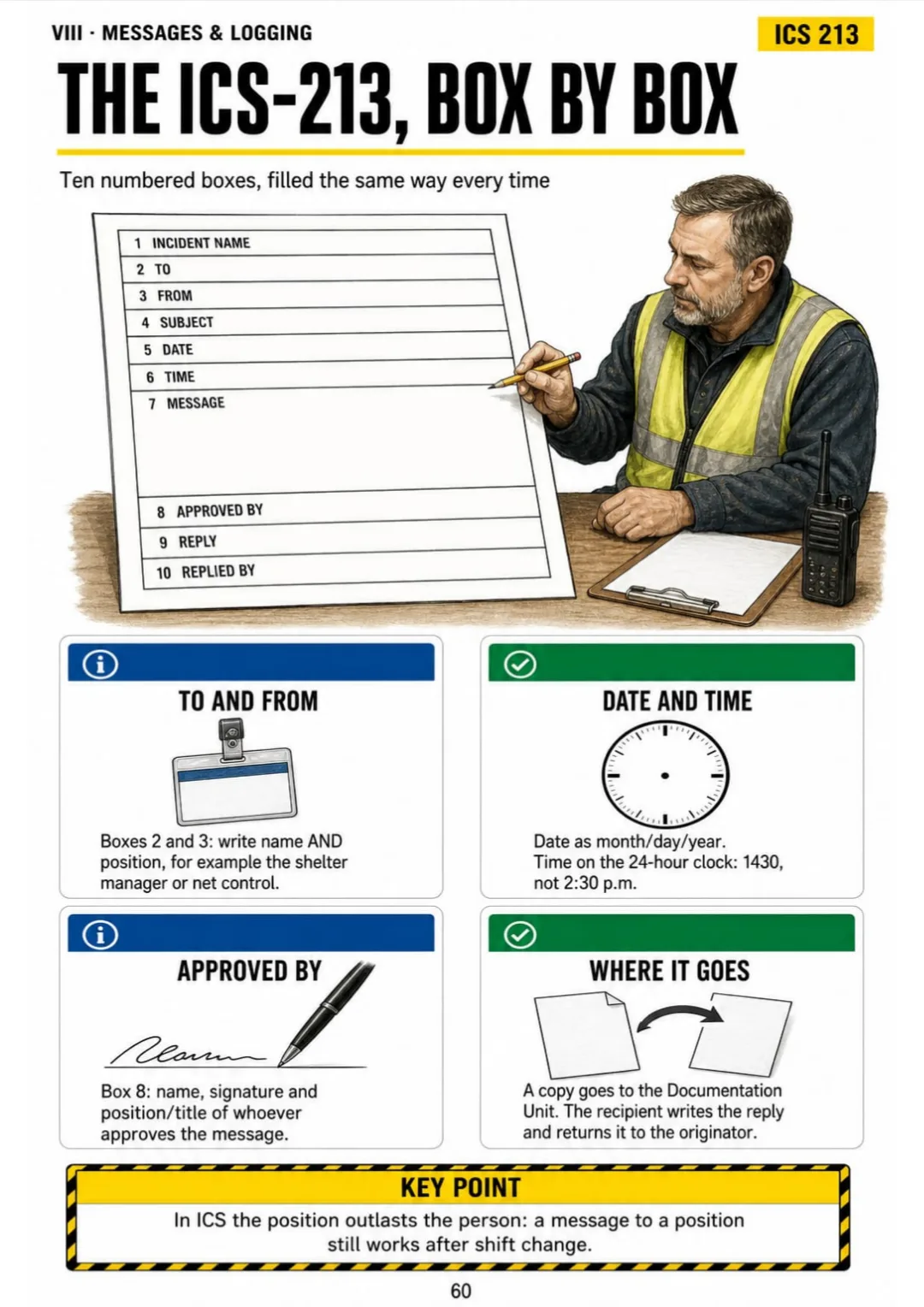
ICS 213 v3: ten boxes, dates month/day/year, times on the 24-hour clock
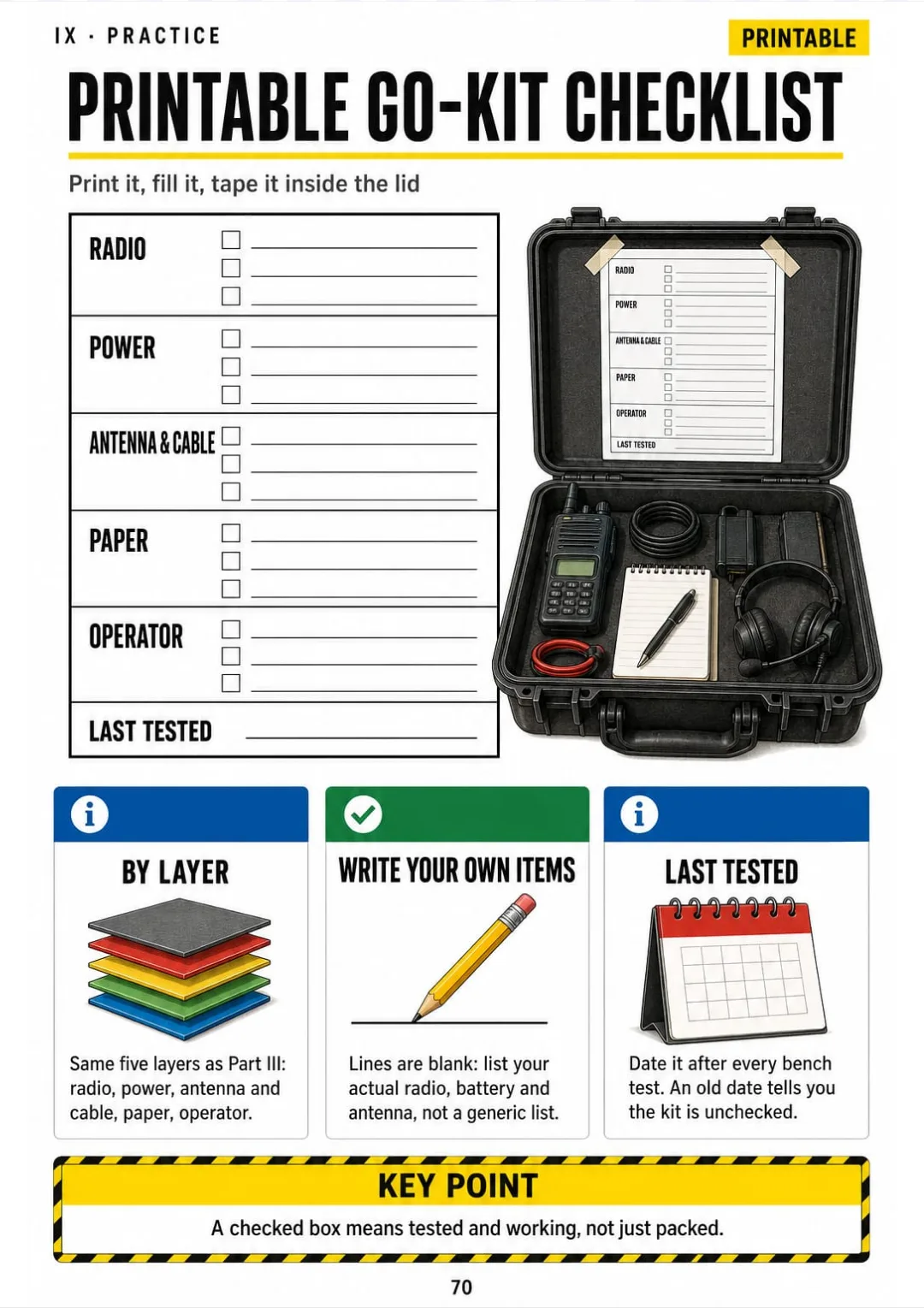
Blank checklist: radio, power, antenna, paper, operator + last tested date

Swipe to see more →

These are real pages from the book. The table of contents is the full one: 9 parts and 69 topics.

The Problem Isn't You. It's How It Was Explained to You.

The repeater on the hill has gone quiet and net control says it: move the net to HF, NVIS on 40 meters. You have the radio and a roll of wire, and you're standing in the yard trying to remember how that dipole is supposed to go up.

The manual covers it in three dense paragraphs: takeoff angles, ionosphere layers, skip zones. Nothing tells you what to actually do with the wire.

NVIS on 40 and 80/75 meters: a low dipole covers 0 to 300 miles when repeaters fail.

In the book, NVIS is one page. A low dipole drawn over the yard, the signal going straight up and coming back down in a circle that covers 0 to 300 miles, with 40 and 80/75 meters marked in the box.

Same with run-time math, SWR, the net check-in, the phonetic alphabet and the message form: each one has its own page.

You see it, you get it, and you put the antenna up without going back to the manual.

COMPARE FOR YOURSELF

The Same Topic, Two Ways to Learn It

THIS
  • The manual: line after line of text
  • Run-time math explained only in words
  • You show up to the deployment with doubts
Operating endurance of a battery-powered station is a function of the battery's usable capacity, expressed in ampere-hours, and the station's average current consumption, which must account for the proportion of time spent in transmit, receive and standby states. Because rated capacity does not equal usable capacity, the operator must first apply a derating factor appropriate to the battery chemistry, then calculate a time-weighted average current from manufacturer specifications, and finally divide the former by the latter to obtain an estimate of run-time in hours, subject to temperature effects.
FOR THIS
  • Run-time math in one drawing
  • The four steps in a box
  • You see it and you get it
Usable Ah ÷ average amps = hours · 18 Ah ÷ 1.72 A ≈ 10.5 h
CONTENTS

Take a Look at the 9 Parts and 69 Topics

Your role, the on-air rules, the go-kit, field power, antennas, simplex and repeaters, nets, messages and logging, and practice with printable checklists: 74 pages, all illustrated.

IYour Role When the Phones Go Down · pp. 6-12
  1. What emergency comms really is
  2. Who you work for: served agencies
  3. ICS in one drawing
  4. Where you fit in the org chart
  5. The free FEMA courses groups ask for
  6. Self-deploying: why it hurts
  7. Your license class and what it opens
IIThe Rules That Apply on the Air · pp. 13-19
  1. Part 97 in five rules you will use
  2. Station ID: every 10 minutes and at the end
  3. Tactical call signs vs your FCC call
  4. When anything goes: the emergency provision
  5. No pay, and the drill exception
  6. Plain language, no codes, no encryption
  7. Privacy on an open frequency
IIIThe Go-Kit, Piece by Piece · pp. 20-26
  1. The 24-hour vs 72-hour kit
  2. The radio layer
  3. The power layer
  4. The antenna and cable layer
  5. The paper layer
  6. The operator layer
  7. Pack, weigh, test
IVField Power and Run-Time Math · pp. 27-35
  1. Amps, volts, watts, amp-hours
  2. What your radio actually draws
  3. Duty cycle: how much you really talk
  4. Run-time in four steps
  5. Battery chemistry: usable capacity
  6. Solar: what a panel really gives you
  7. Turn the power down, stretch the battery
  8. Generator safety
  9. Fuses and wire size
VAntennas You Can Put Up in the Field · pp. 36-44
  1. Why the antenna matters more than watts
  2. Quarter-wave ground plane for 2 meters
  3. The roll-up J-pole
  4. Half-wave dipole for HF
  5. NVIS: talking 0 to 300 miles on HF
  6. End-fed wire with a transformer
  7. Reading SWR without panic
  8. Coax loss: why the cable matters
  9. Getting the wire up safely
VISimplex, Repeaters and Bands · pp. 45-51
  1. Simplex vs repeater in one drawing
  2. Repeater offset and tone
  3. National simplex calling frequencies
  4. Line of sight and terrain
  5. HF bands for regional nets
  6. Programming your radio before the call
  7. Digital modes in one page
VIINets, Check-Ins and Voice Procedure · pp. 52-59
  1. Directed vs open net
  2. The check-in, always in the same order
  3. Emergency and priority traffic first
  4. The phonetic alphabet
  5. Procedure words that save time
  6. Listen first, then key up
  7. Being net control: the basic script
  8. Relays: when you hear what net control cannot
VIIIMessages and Logging · pp. 60-67
  1. The ICS-213 general message, box by box
  2. The formal radiogram header
  3. Counting words for the check
  4. Reading a message for copying
  5. Read-back: the step people skip
  6. The ICS-214 activity log
  7. The ICS-205 radio plan and the ICS-309 comms log
  8. Shift change and handoff
IXPractice, Checklists and Common Mistakes · pp. 68-74
  1. Most common mistakes on the air
  2. Most common mistakes in the go-kit
  3. Printable go-kit checklist
  4. Printable run-time worksheet
  5. Printable contact log
  6. Family comms plan card
  7. Before, during, after: the one-page summary

One Page, One Topic, All Clear

Think of it this way:

It's hour six of an outage. Your battery is half gone and net control asks how long you can stay on the air.

You open the book to the run-time page and it's drawn: usable amp-hours divided by average amps, in four steps, with a worked example of 18 Ah ÷ 1.72 A ≈ 10.5 hours.

Check-in in 5 steps: wait, call sign phonetically, name, location, traffic

Same with the go-kit, the check-in, the message form, SWR and NVIS: each one on its own page.

Ham Radio Emergency Comms Illustrated is 9 parts and 69 topics, all drawn, with a printable go-kit checklist, a run-time worksheet, a contact log and a family comms plan card at the end.

What you see drawn, you don't have to memorize.

What's Inside Ham Radio Emergency Comms Illustrated:

Ipp. 6-12

Your Role When the Phones Go Down

What emergency comms really is, the served agencies you work for, incident command in one drawing, where you fit in the org chart, the free federal courses most groups ask for, why self-deploying causes problems and what your license class lets you do.

IIpp. 13-19

The Rules That Apply on the Air

Part 97 in five rules you'll use, station ID every 10 minutes and at the end, tactical calls vs your own call sign, the emergency provision, no pay and the drill exception, plain language and privacy on an open frequency.

IIIpp. 20-26

The Go-Kit, Piece by Piece

The 24-hour vs 72-hour kit, then layer by layer: radio, power, antenna and cable, paper and operator, and how to pack, weigh and test it all.

IVpp. 27-35

Field Power and Run-Time Math

Amps, volts, watts and amp-hours, what your radio really draws, duty cycle, run-time in four steps, battery chemistry, solar, turning the power down, generator safety, fuses and wire size. So when net control asks how long you can stay on, you answer with a number.

Vpp. 36-44

Antennas You Can Put Up in the Field

Why the antenna matters more than watts, the 2-meter ground plane, the roll-up J-pole, the HF dipole, NVIS, the end-fed wire, reading SWR, coax loss and getting the wire up safely.

VIpp. 45-51

Simplex, Repeaters and Bands

Simplex vs repeater, offset and tone, national simplex calling frequencies, line of sight and terrain, HF bands for regional nets, programming before the call and digital modes.

VIIpp. 52-59

Nets, Check-Ins and Voice Procedure

Directed vs open nets, the check-in always in the same order, emergency and priority traffic first, the phonetic alphabet, procedure words, listening first, the net control script and relays. So the check-in comes out in order when net control calls your sign.

VIIIpp. 60-67

Messages and Logging

The general message form box by box, the radiogram header, counting words for the check, copying, read-back, the activity log, the radio plan and comms log, and shift handoff.

IXpp. 68-74

Practice, Checklists and Common Mistakes

The most common mistakes on the air and in the go-kit, plus a printable go-kit checklist, run-time worksheet, contact log, family comms plan card and the one-page summary.

At the end of the book: Printable go-kit checklist, run-time worksheet, contact log and family comms plan card.
Plus: 2 Free Books

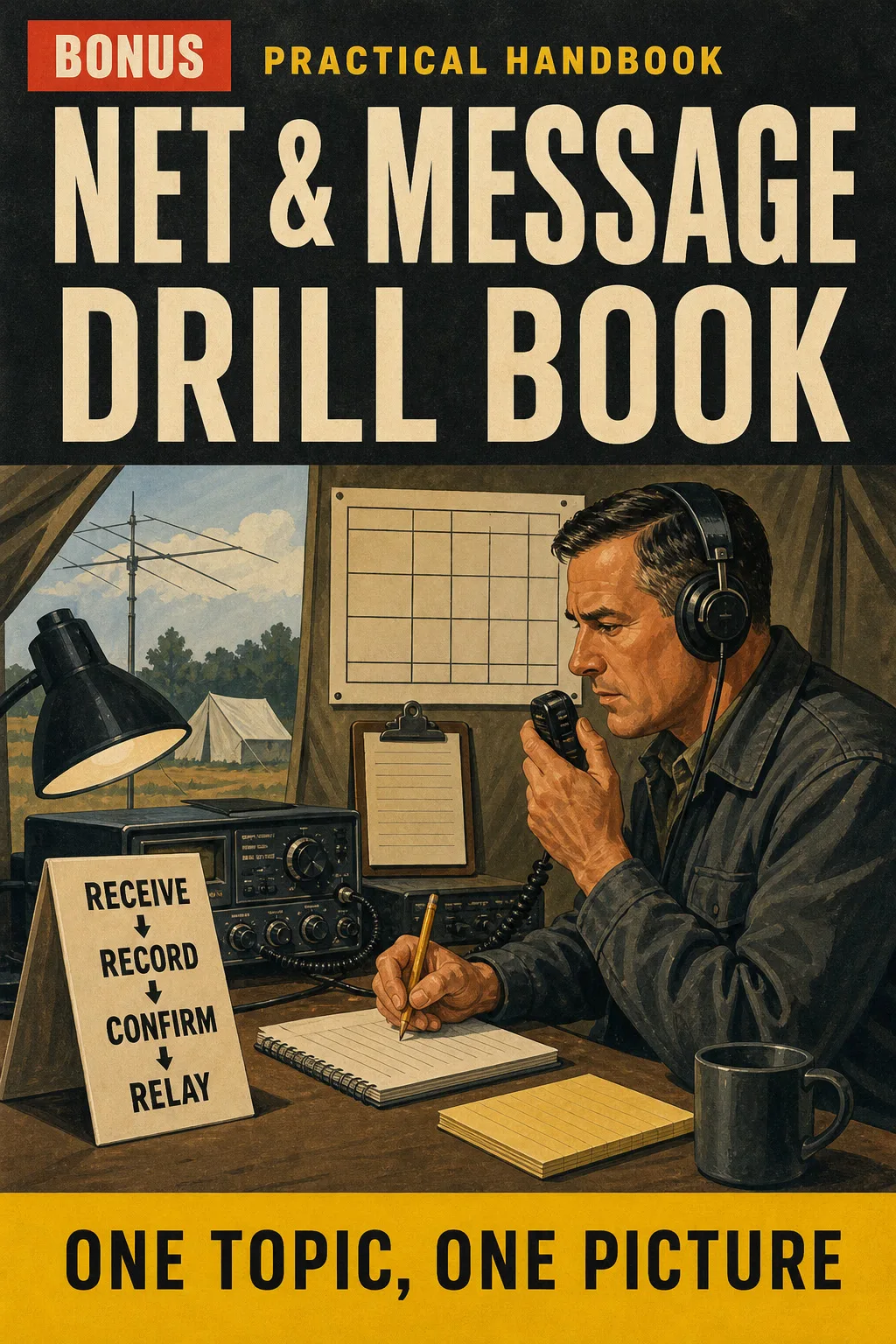
Net & Message Drill Book

BONUS 1: «Net & Message Drill Book»

Value on its own: US$ 17.90

Drills you can run with your local group: check-ins, relays and filling in a message form, with worked answer pages so you practice the order before it counts.

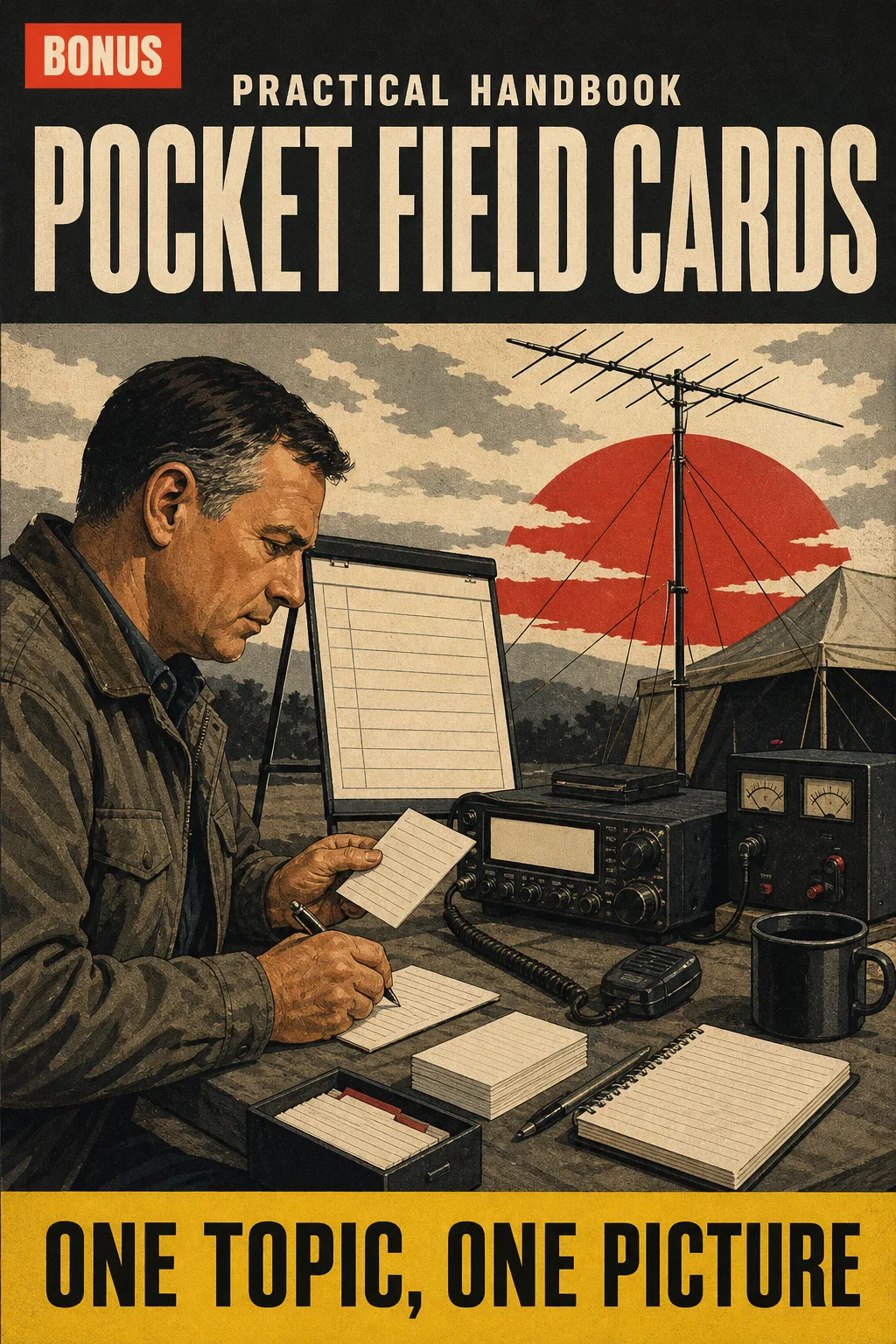
Pocket Field Cards

BONUS 2: «Pocket Field Cards»

Value on its own: US$ 14.90

Printable quick-reference cards for your go-kit: phonetic alphabet, check-in sequence, message form steps and run-time math, all at a glance when your mind goes blank.

Black Friday week · ends Nov 30

Ham Radio Emergency Comms Illustrated with 2 Free Books

  • Ham Radio Emergency Comms Illustrated: 74 illustrated pagesUS$ 63
  • BONUS 1: Net & Message Drill BookUS$ 17.90
  • BONUS 2: Pocket Field CardsUS$ 14.90
  • High-resolution PDF to printIncluded
Total value US$ 95.80
BLACK FRIDAY PRICE:
US$ 27
You save US$ 68.80
YES, I WANT HAM RADIO EMERGENCY COMMS ILLUSTRATED FOR US$ 27

📄 This is a digital PDF book sent to your email: nothing is printed or shipped.

Secure purchaseEncrypted payment30-day guarantee

PDF by email: We email you Ham Radio Emergency Comms Illustrated as a PDF, together with the two free books. It's a single payment: no installments, no extra charges.

Who This Book Is For

You just joined your county's comms group

You just joined your county's comms group

You get the whole picture in order: who you report to, what goes in the go-kit and how a net runs, one page at a time.

Your first drill is coming up

Your first drill is coming up

You practice the check-in, the message form and the read-back with the drill book, so the order is there when net control calls your sign.

You've been on the air for years

You've been on the air for years

You get the run-time math, NVIS and the paperwork drawn in one place, printed and ready in your go-kit.

Everything You Get Today

US$ 95.80US$ 27
YES, I WANT HAM RADIO EMERGENCY COMMS ILLUSTRATED FOR US$ 27

📄 This is a digital PDF book sent to your email: nothing is printed or shipped.

30DAYS
GUARANTEE

30-Day Guarantee

Try Ham Radio Emergency Comms Illustrated for 30 days, bonus books included.

We refund everything if the file won't open, if the book isn't what you see here, if you were charged twice or if the email doesn't arrive. Just email us.

You pay once. No subscriptions.

Frequently Asked Questions

Is it for me if I've had my call sign for years but never worked an emergency net?

Yes. It starts with your role and the rules, then goes task by task. If you already operate, you'll have the field steps, run-time math and paperwork in one place.

Where does the content come from?

Everything is written for the US. The on-air rules are checked against the current FCC amateur radio rules (47 CFR Part 97 on eCFR), and roles and forms against FEMA's NIMS and ICS guidance. Bands, license privileges and national simplex frequencies are the US ones.

Is this official material?

No. It's an independent illustrated guide. It isn't published, approved or endorsed by any agency or amateur radio organization.

Does it replace my group's training?

No. It helps you review and practice, but your group's training, its drills and the instructions of your served agency always come first. It doesn't give a certificate or count as credit for any federal course.

Will it help me pass the Technician or General license exam?

No. It isn't exam prep. It covers what you do on an emergency net once you're licensed. For the license exams, study the current question pool. The drills in this book are written for practice, not taken from any group or agency.

When and how does it arrive?

As a PDF by email, at the address you enter at checkout. The 2 gift books arrive the same way: the Net & Message Drill Book, to practice check-ins, message forms and read-backs, and the Pocket Field Cards, the key steps on cards you print for the go-kit.

Do I have to pay every month?

No. It's a one-time payment, with no subscription.

Can I have it on paper?

Yes. Print it at home or at a print shop and keep it in your go-kit. The checklists and cards are made to print.

How does the refund work?

You have 30 days. We refund everything if the file won't open, if the book isn't what you see on this page, if you were charged twice or if the email doesn't arrive: just email us.

Before You Close This Page

No more rereading pages that don't stick.

The check-in and the message form: you see them drawn and you're set.

You show up to the net knowing where everything is.

Drawings make studying faster.

The book is right below.

One-time payment: US$ 27 · Guarantee: 30 days · PDF by email

YES, I WANT HAM RADIO EMERGENCY COMMS ILLUSTRATED FOR US$ 27

📄 This is a digital PDF book sent to your email: nothing is printed or shipped.